

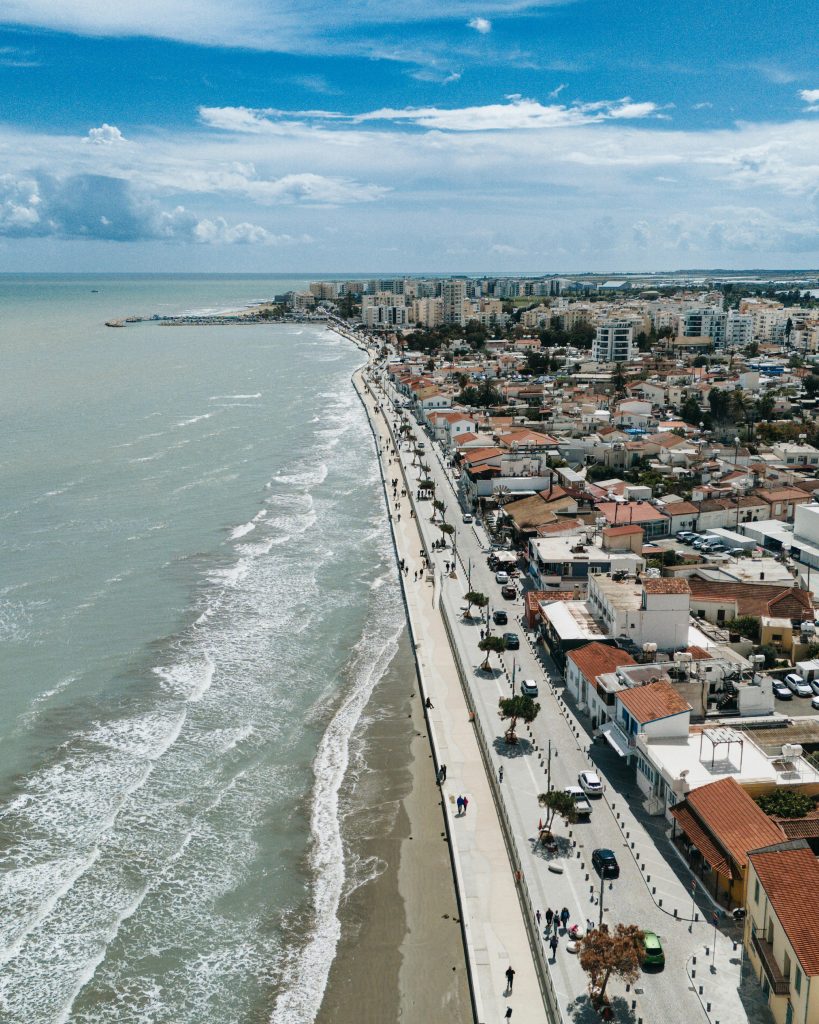
Larnaca is gaining serious investor attention because it offers four things at once: lower property entry costs than Limassol, direct adjacency to Cyprus’s busiest international airport, a long working seafront with year-round visitor traffic, and a tourism profile that has grown materially through the last two years. Each factor has investor implications. Together, they describe a market that is no longer the hidden alternative it was five years ago.
The “hidden gem” framing has become the conventional wisdom on Larnaca, and the market data is starting to catch up with the headline.
What Larnaca Offers Investors at a Glance
Five facts that frame the city for an investment thesis:
- Airport adjacency: Larnaca International is Cyprus’s primary airport. In August 2025 it handled 1.3 million passengers in a single month, up on August 2024 (Cyprus Statistical Service via Cyprus Mail, accessed 10 May 2026).
- Tourist share: Larnaka attracted 14.2% of Cyprus tourist arrivals in 2024, on a national base of 4,040,200 (Cyprus Statistical Service / OEB Tourism Statistics 2024, accessed 10 May 2026). National arrivals climbed 12.2% to 4,534,073 in 2025.
- Property entry cost: Larnaca’s median residential price sat at EUR 310,500, compared with Limassol’s EUR 660,000, making it the most affordable major district (Global Property Guide / RICS, accessed 10 May 2026).
- Long-term rental yield band: Larnaca yields are reported in the 4% to 6% range depending on property type, with apartment growth at 4.2% in Q1 2025 and new-build sales rising 40% through 2024 (Global Property Guide / Clover.Tax, accessed 10 May 2026).
- Visitor type: a mix of summer beach tourism (Phinikoudes promenade and adjacent), shoulder-season cultural visitors, and year-round airport-driven business and transit travellers.
Numbers establish the frame. The next sections work through what each one means in practice.
Why Larnaca’s Property Entry Cost Still Favours Newer Investors
Larnaca’s entry-cost advantage is the single most consequential investor-side factor. A residential apartment that costs EUR 250,000 in Larnaca often costs EUR 450,000 to 600,000 for an equivalent layout in central Limassol. The 1.5x to 2x price differential changes everything about an investment thesis: deposit requirements, mortgage exposure, capital efficiency on first-property entry, and the size of portfolio an investor can build at a given capital base.
The differential is also closing slowly, not quickly. Larnaca apartment prices grew at 4.2% in Q1 2025, faster than the national average, and new-build sales rose 40% in 2024. The market is moving, which is what produces the “gem” framing in the first place. Investors who prioritise total return on capital deployed often find Larnaca pencils out better than Limassol on the same underlying assumptions, because the higher Limassol rents do not always cover the much higher Limassol acquisition cost.
Our team’s Larnaca base gives Lazuli Management a working view of the local market that distant operators cannot match. Local knowledge matters more on this market than on more transparent ones.
The Tourism Profile: Who Visits Larnaca and When
Summer and shoulder-season demand
Phinikoudes beach, Mackenzie beach, and the broader seafront drive the bulk of summer demand. The summer profile skews to families, couples, and small groups from the United Kingdom (the largest single source market at 31.4% of Cyprus arrivals in 2025), Israel, and Germany. Shoulder seasons (April to May, September to October) extend the tourism calendar meaningfully on Larnaca’s seafront properties, in a way that does not hold as strongly for inland or mid-Cyprus locations.
Year-round demand drivers (airport business travellers, expats)
Larnaca’s airport produces a baseline of year-round demand that genuinely beach-only Cyprus markets do not have. Business travellers, transit guests, and short-stay expats use Larnaca short-term rentals through winter months, particularly in properties within 10 to 15 minutes of the airport or central business areas. This baseline narrows the seasonal trough that purer beach markets experience, which improves annual occupancy maths.
Operational Considerations for Larnaca Short-Term Rentals
The factors that govern operational performance hold across the island, but Larnaca’s specifics tilt the balance:
- Distance to airport simplifies guest arrivals and produces a higher proportion of short-stay (one to three night) bookings than other Cyprus markets, which raises turnover frequency.
- Seafront concentration means many high-performing properties sit within a small geographic footprint, which makes operational logistics (cleaning teams, maintenance contractors, owner liaison) more efficient on a portfolio basis than scattered locations.
- Mixed-use neighbourhoods mean noise and parking management become operational considerations more often than in pure-residential locations. Listings should set expectations honestly.
The substance of the operational running of a Larnaca short-term rental has more in common with hospitality than with traditional landlord work. The operational cadence on a Larnaca seafront unit in July is not optional and does not flex.
Where Larnaca Fits a Short-Term Rental Investment Thesis
Larnaca fits an investment thesis built around capital efficiency, year-round occupancy resilience, and a growing-but-not-overheated market. It suits investors entering Cyprus property for the first time at an accessible price point, investors building a portfolio across multiple units rather than one premium asset, and investors who value the operational logistics of a concentrated city-centre and seafront footprint.
It fits less well for investors targeting the absolute peak of Cyprus nightly rates (which Limassol’s premium tourist strip retains), or for investors whose thesis depends on the highest possible single-property absolute return rather than capital-efficient compounding.
The strategic frame around all of this is also worth a separate read. We covered the short-term versus long-term decision in Cyprus at length in a sister post, and the answer there shapes how Larnaca’s specific characteristics map to a specific investor profile. Investor-side advisory on Cyprus portfolio strategy is the logical next step for investors who have decided Larnaca is in scope and now need to model specific properties.
Frequently Asked Questions
For investors weighing capital efficiency against absolute return, Larnaca is among the strongest options on the island. The combination of lower entry costs (median residential price around EUR 310,500), airport adjacency, a long working seafront, and growing year-round tourism gives investors a market with genuine upside and meaningfully lower exposure than the Limassol premium tier. The trade-off is that absolute peak nightly rates remain higher in Limassol; investors choosing Larnaca prioritise capital efficiency and resilience over peak performance.
Limassol commands higher absolute prices, higher absolute rents (around EUR 3,057 monthly average versus Larnaca’s EUR 1,277), and stronger year-round corporate-adjacent demand. Larnaca offers lower entry costs (median EUR 310,500 versus Limassol’s EUR 660,000), direct airport access, and a tourism profile that has grown materially through 2024 and 2025. The right answer depends on the investor’s profile and capital base. Limassol favours investors who want premium positioning and absolute return per unit; Larnaca favours investors who want capital efficiency and portfolio scale.
One and two-bedroom apartments within 15 minutes of either Phinikoudes seafront or Larnaca airport tend to perform strongly across both summer beach demand and year-round airport-driven travellers. Properties with outdoor space (balcony, terrace) command premium nightly rates. Three-bedroom layouts in residential interior locations often pencil out better as long-term lets than as short-term rentals, because the dominant Larnaca tourism guest profile is couples and small families rather than larger groups.
Larnaca International Airport sits roughly 10 minutes by road from central Larnaca and 15 minutes from the seafront properties on the southern coast. The proximity is a meaningful operational advantage for short-term rentals: simpler guest arrivals, higher proportion of one to three night bookings driven by airport traffic, and a baseline of year-round business and transit demand that pure beach markets in Cyprus do not have.
If you are weighing a Larnaca property and want a structured read on its specific potential, our team is positioned locally and ready to talk to our team about a Larnaca property and walk through what the numbers actually look like.
